Estimation of magnitude and epicentral distance
from seismic waves using deeper CRNN
IEEE Geoscience and Remote Sensing Letters (GRSL), 2023
Dongsik Yoon, Yuanming Li, Bonhwa Ku, Hanseok Ko
Korea University
Abstract
Estimating earthquake parameters is an essential process for an earthquake analysis system. In particular, the magnitude and epicentral distance of an earthquake are the most basic parameters in earthquake analysis. To estimate these, existing approaches require long waveform data from multiple stations.
In this paper, we propose a novel estimation method based on multi-tasking deep learning and a convolutional recurrent neural network using only a single station. We also use the stream maximum of the input waveform to accurately estimate the earthquake magnitude.
Based on evaluation using the Stanford Earthquake dataset (STEAD) and the Kiban Kyoshin Network (KiK-net) dataset, we verify the high performance of the proposed method.
Proposed Methods
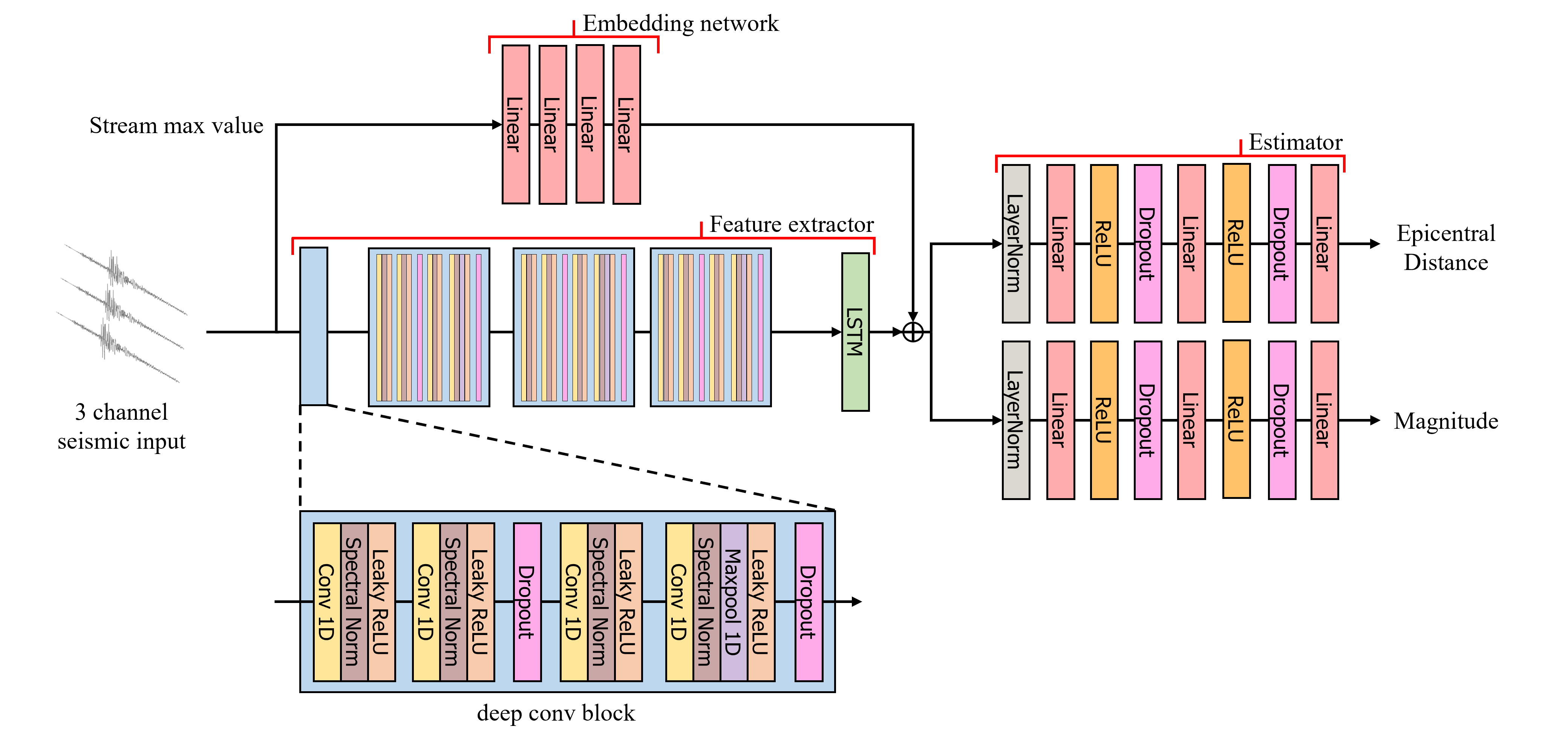
Summary of our proposed architecture. For clarity, we divide our architecture into three parts: CRNN-based feature extractor, 4-layer MLP embedding network, and estimator.
Experimental Results
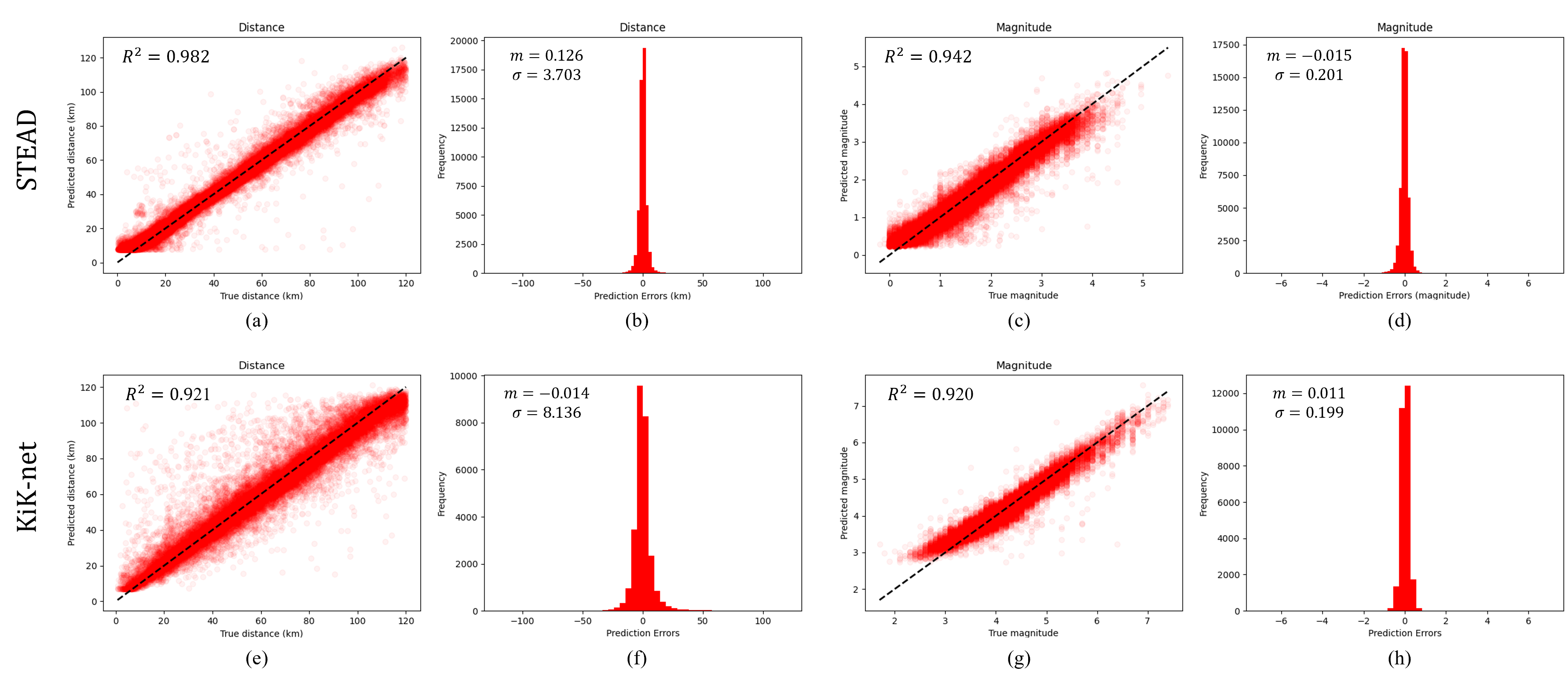
Estimation results of the proposed architecture using the test datasets. The first and third columns illustrate the ground truth versus the expected values for the epicentral distance and magnitude. The dotted line represents the ideal result in which the error is equal to 0. The coefficient of determination (R2) is provided. The second and fourth columns present histograms for the distribution of error for the epicentral distance and magnitude. The error follows a Gaussian distribution. The mean (m) and standard deviation (σ) are provided.

This table summarizes the results comparing our method with these existing methods in terms of the mean absolute error (MAE), which measures the difference between the ground truth values and the corresponding predicted values. The best results in each column are boldfaced.